
Stainless Steel Tube Wall Thickness and Pressure: What Buyers Need to Check
Stainless steel tubing does not have one pressure rating based on grade or outside diameter alone. Assess the tube dimensions, material condition, temperature and applicable design requirements, then check the fittings, valves and other components in the assembly. The tube wall is part of that assessment, not the complete answer.
For procurement teams, the practical consequence is simple: a request for “12 mm stainless tube for high pressure” needs more information. The supplier needs the wall thickness or design conditions, the intended connection system and the required documentation to propose a suitable product.
Understand OD wall thickness and bore
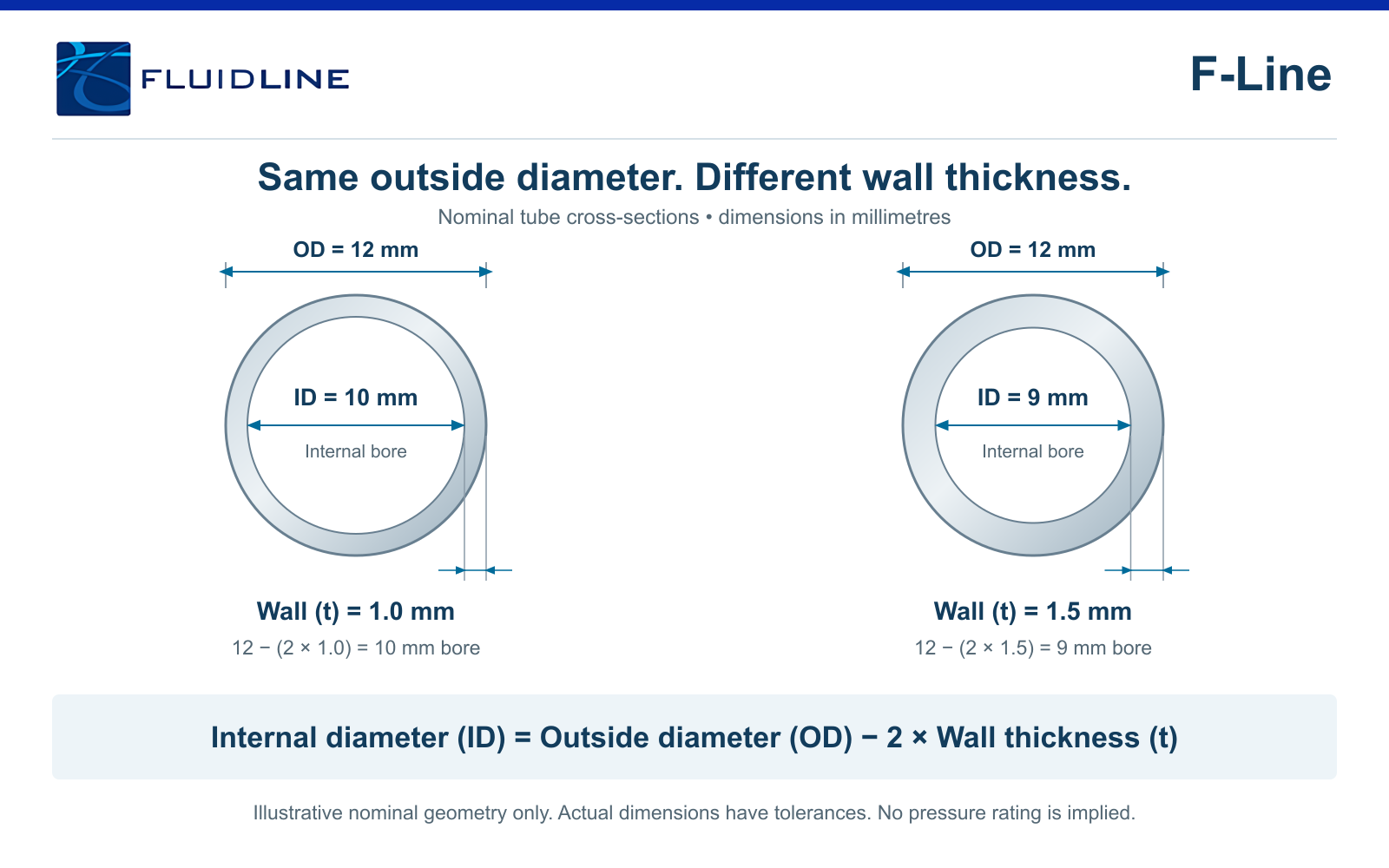
Outside diameter, or OD, determines the external tube size. Wall thickness describes the metal between the outside and inside surfaces. For a nominal round tube, the internal diameter is the OD minus twice the wall thickness.
| Illustrative tube dimension | Nominal internal diameter | What this establishes |
|---|---|---|
| 12 mm OD × 1.0 mm wall | 10 mm | Nominal geometry only. |
| 12 mm OD × 1.5 mm wall | 9 mm | Thicker wall and a smaller nominal bore. |
These dimensions are not pressure recommendations. Actual dimensions are subject to the specified tolerances. At the same OD, a thicker wall reduces the internal flow area, so a substitution can affect flow and pressure loss as well as mechanical behaviour.
Use a pressure reference that matches the product
Read the conditions attached to a pressure table before using a value. Confirm the material, tube condition, dimensions, units, reference temperature and calculation or test basis. Check whether the table covers tubing alone or a particular tubing-and-fitting combination.
Do not transfer a value from a different material, fitting range or tube condition simply because the OD matches. Where the project requires a design calculation, the responsible engineer should apply the specified design code and relevant allowances.
Temperature and service conditions matter
A published room-temperature rating may require adjustment at elevated temperature. Apply the temperature guidance for the actual material and component, including any seals. Identify the design temperature as well as normal operating conditions.
Also describe pressure peaks, cycling, vibration and the process medium. State explicitly if the service is gas. The selected fitting catalogue may impose additional wall-thickness or application restrictions that cannot be inferred from a liquid-service pressure figure.
Check the whole assembly
Increasing tube wall thickness does not increase the rating of an existing valve, adaptor or fitting. The allowable operating envelope must respect every component’s applicable limits and the design requirements for the assembled system.
The tube must also be suitable for the connection method. Confirm surface condition, hardness and permitted wall range against the chosen fitting instructions. Consider the proposed bending method, tube supports and installation access before approving a different wall thickness.
Keep specification certification and pressure assessment separate
An ASTM specification establishes defined product requirements. An inspection certificate documents the relevant material and inspection results for the supplied product. Neither replaces an assessment of the completed installation at its design conditions.
F-Line straight seamless stainless steel tubing is supplied with EN 10204 Type 3.2 certification by TÜV as standard. Keep those records associated with the tube identification and specify any additional project requirements when ordering.
Information to send with a pressure selection enquiry
- Required material, specification, OD and proposed wall thickness.
- Normal and design pressure, including relevant transient conditions.
- Operating and design temperature, and the process medium.
- Required flow, approximate run length and routing constraints.
- Fitting system, valves and any existing component references.
- Applicable design requirements and inspection documentation.
Frequently asked questions
Does thicker tubing always make an installation suitable for higher pressure?
No. A thicker wall may improve the tube’s pressure capacity under comparable conditions, but the fittings, valves, temperature limits and installation design still require checking.
Can a tube pressure table be used at any temperature?
No. Use the stated reference conditions and applicable temperature adjustments. Check seal and component limitations separately.
Can Fluidline quote if the wall thickness is not yet selected?
Send the service conditions and project requirements with the enquiry. This provides a basis for discussing available options; final selection must satisfy the application’s engineering requirements.
Prepare a complete tube enquiry
Use the size and pressure-selection resources below, then send your requirements to ram@fluidline.co.za. Include the fitting system so that tubing and connections can be considered together.